
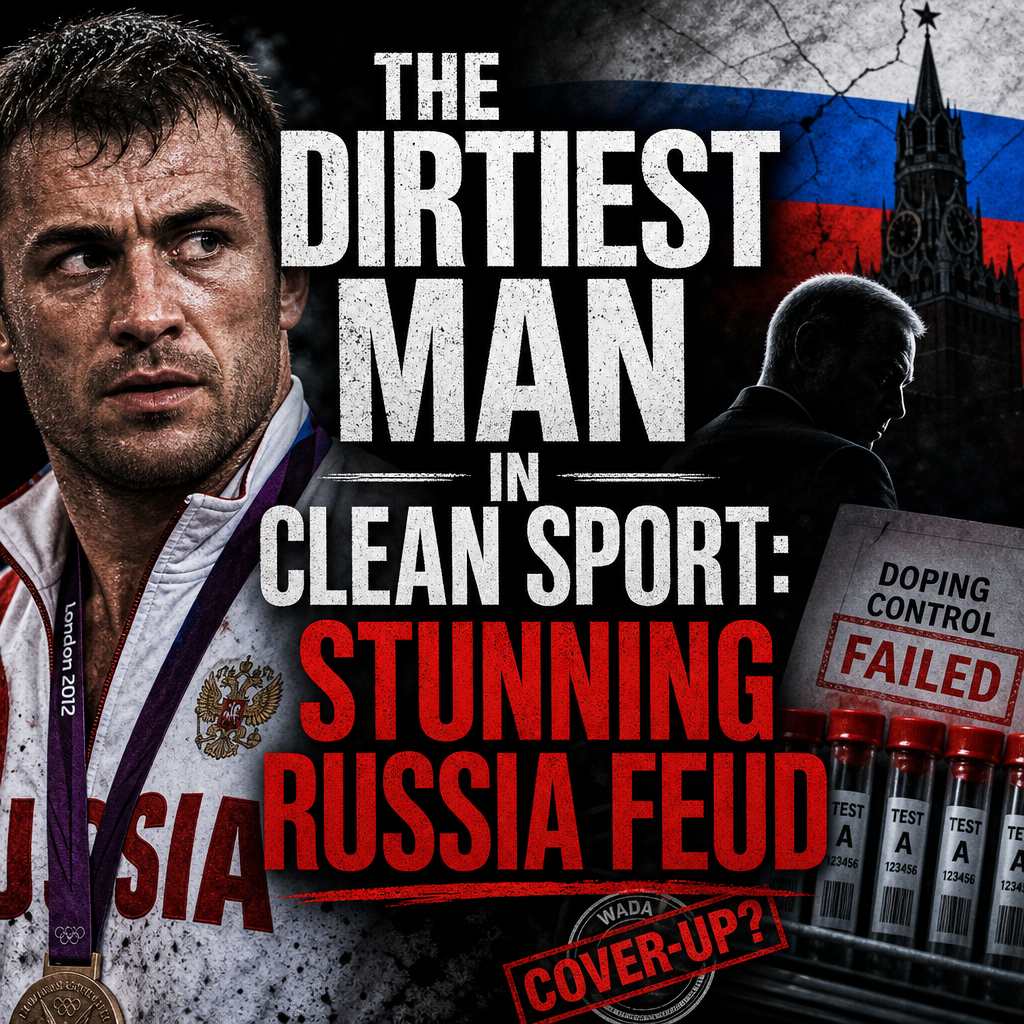
The Dirtiest Man in Clean Sport: Stunning Russia Feud


The dirtiest man in clean sport has become an unlikely flashpoint in a wider Russia feud over who gets to define fairness, accountability, and credibility in elite athletics.
At first glance, the argument sounds almost self-defeating: a battle over “clean sport” involving a country that has spent years under scrutiny for state-linked doping violations. But that is exactly why the latest row matters. Different outlets frame it in sharply different ways, yet they converge on one core point: this is not just about one person’s reputation. It is about whether anti-doping rules are being enforced consistently, or selectively, in a world where sport and politics are increasingly tangled together.



The Russia feud is about more than one accusation
The most combustible versions of the story, as reflected in Russia-focused coverage, portray a bitter internal and external campaign in which a prominent figure is being attacked as the embodiment of hypocrisy. That framing casts the dispute as an assault on Russian sport rather than a straightforward clean-sport issue. In that telling, the outrage is less about evidence and more about symbolism: Russia is still being punished, still being singled out, and still being used as a convenient target.
Other coverage, including international reporting on anti-doping and Russian sport, tends to land in a very different place. From this perspective, the central issue is not whether Russia is treated unfairly; it is whether the system has enough trust left to withstand repeated controversy. Years of investigations, sanctions, and admissions have left a residue of suspicion. Even when individual athletes or officials insist they have been treated unjustly, the broader public tends to read the dispute through the lens of past violations.




That’s why the phrase “dirtiest man in clean sport” has such bite. It is part accusation, part political weapon, and part media shorthand for a deeper credibility crisis. Once that kind of label enters the debate, it becomes almost impossible to separate the individual from the institution.
Clean sport, dirty politics
If there is one thing the available coverage makes clear, it is that anti-doping is never purely technical. It is legal, scientific, bureaucratic, and political all at once. Testing regimes, sample custody, appeals, lab standards, and sanction procedures matter enormously. But so do timing, optics, and the perception of fairness.
What the competing narratives say
There are at least three distinct viewpoints in play:
– The Russian-state or pro-Russia view: the episode is seen as proof that international sport still treats Russians as guilty until proven innocent.
– The anti-doping enforcement view: the controversy reinforces the need for strict controls, because any weakness invites manipulation and erodes trust.
– The skeptical middle view: both sides are partly right, because anti-doping bodies have at times been opaque, while Russia’s record makes innocence claims difficult to accept at face value.
That middle position may be the least dramatic, but it is probably the most credible. It recognizes that international institutions can overreach, while also acknowledging that Russia’s own history has made clean-sport arguments harder to defend. In other words, accusations of bias do not erase the underlying scandal; and past scandals do not automatically justify every present sanction.
Sky’s broader international lens tends to emphasize the human and diplomatic fallout: athletes caught in the crossfire, sporting bodies trying to avoid open political confrontation, and fans left wondering whether results can be trusted. Al Jazeera’s style of coverage more often situates Russian sport within the larger geopolitical environment, where sanctions, isolation, and national narratives all shape how every new dispute is interpreted. RT, by contrast, is more likely to foreground perceived double standards and present the feud as evidence of an anti-Russia bias embedded in global sport.
Taken together, those perspectives reveal why the story travels so widely. It is not simply a niche anti-doping dispute. It is a proxy fight over institutional legitimacy.
Why this feud keeps resurfacing
The persistence of these controversies suggests a problem that no single ruling can solve. Even when sanctions are imposed or investigations conclude, the legitimacy gap remains. Fans who already distrust international federations see confirmation of their suspicions. Those who believe Russia has repeatedly failed to clean up its sport see yet another attempt to muddy the waters.
A fair reading of the situation should hold both ideas in tension:
– Russia has real reasons to complain about inconsistencies and politicized rhetoric.
– International sport has real reasons to remain vigilant given the country’s history of doping cases.
– Athletes, especially those not involved in misconduct, are often the ones who pay the highest price.
That last point matters more than the shouting usually allows. Anti-doping systems are designed to protect clean athletes, but when disputes become endlessly political, the people most affected are often those trying to compete honestly.
A dispute with no easy winner
The strongest conclusion, at least for now, is that this feud exposes a broken trust relationship rather than a single clear villain. If the Russian side is right that double standards exist, then global sport must address them more transparently. If the enforcement side is right that Russia remains uniquely problematic, then credibility demands firm and consistent sanctions, not rhetorical fog.
What would help most is not another round of slogans, but clearer evidence, more transparent procedures, and less selective outrage. Until then, every new scandal will be read as either a vendetta or a cover-up depending on where the audience already stands.
And that is the true scandal behind the “clean sport” label: when trust is this damaged, even the language of fairness starts to sound political.